
$57


Download Functional and Reactive Domain Modeling
Download Functional and Reactive Domain Modeling
Among motivating factors that you can decided to get this publication is due to the fact that this is extremely appropriate to the problem that you face currently. The condition is not just for you that are not afraid to obtain new point, for you who always really feel that you need new sources making better life. And also this publication is extremely proper to check out also in only short leisure time. Yeah, with the soft documents of Functional And Reactive Domain Modeling, you could take easy to constantly check out as well as read this publication again.
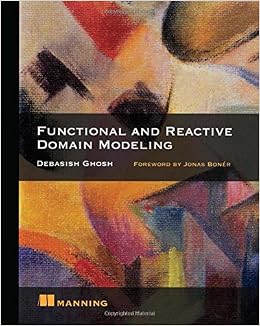
Functional and Reactive Domain Modeling

Download Functional and Reactive Domain Modeling
In this age of contemporary age, the use of internet should be made the most of. Yeah, net will certainly help us very much not just for essential thing however additionally for daily activities. Many individuals now, from any degree can make use of net. The resources of web link could also be appreciated in several locations. As one of the advantages is to get the online publication, as the globe home window, as lots of people suggest.
Yet, this is not type of sacral advice. Publication can help you solve and from the issue, yet, it can't decide how you will resolve it. It will certainly not offer you the guarantee. You are the one who ought to take it. When taking guide readies method, it will rely on be nothing when you don't read it well. Having Functional And Reactive Domain Modeling will certainly suggest absolutely nothing when you can not use the material and also gaining from this publication.
This is not type of boring means and task to read the book. This is not kind of challenging time to appreciate reviewing publication. This is a great time to have a good time by reviewing book. Besides, by checking out Functional And Reactive Domain Modeling, you could obtain the lessons and also experiences if you do not have any suggestions to do. And exactly what you should obtain currently is not kind of difficult point. This is a very easy thing, just reviewing.
Interested in this publication is must. You could be other people who need the details and also news concerning the topic that have been written in this book. The Functional And Reactive Domain Modeling problem concerning the fascinating topic related to the condition today. When you have actually made a decision to buy this book, you can see the link here. It will directly worry you to acquire guide as yours. And also the soft documents is just what you could give to you. Allow's get the book and read it currently.
About the Author
Debasish Ghosh is a software architect with extensive experience in domain modeling. Debasish uses Scala and Akka in his daily work and was one of the earliest adopters of event sourcing using EventSourced, now called Akka Persistence. He's the author of DSLs in Action, published by Manning in 2010.
Read more
Product details
Paperback: 320 pages
Publisher: Manning Publications; 1 edition (October 24, 2016)
Language: English
ISBN-10: 1617292249
ISBN-13: 978-1617292248
Product Dimensions:
7.3 x 0.9 x 9.1 inches
Shipping Weight: 1.2 pounds (View shipping rates and policies)
Average Customer Review:
3.5 out of 5 stars
10 customer reviews
Amazon Best Sellers Rank:
#411,324 in Books (See Top 100 in Books)
A mind-blowing book that shows how to combine the beauty and orderliness of Domain-Driven Design (Eric Evans) with the purity and reasonability of functional programming and with the need for making your systems reactive. Covers some juicy category theory and abstract algebra principles without going too deep into the math.
Cannot continuing reading it. The style of writing in this book is so poor that I have to put it down. Barely made it to chapter 3. Don't know if I can pick it up again. The problem is that there are too many transitions and references forward and backward to what was said in the last chapter, last section, last paragraph; to what will be covered next, in the next section, in the next chapter... Ugh. Too much of the author in it also. I don't want to read a technology book and keep remembering there's an author. It's like watching a movie and being constantly reminded that there's a director directing a film. If I wanted an author, I'd read fiction.# # #Some examples from chapter 2:Section 2.3.1, "You've probably noticed that I've been using the term 'pure functions' in the context of modeling behaviors[1]. I did this in chapter 1 as well and explained how purity helps you reason about your functions. To recap, a function is pure if it doesn't have any side effects. And what's a side effect? A side effect is something that's not within the control of the function that you implement. If you're manipulating the filesystem... This section presents optimizations you can perform on your model..." The page has a footnote ([1]) that says this:"You've already seen the virtues of pure abstractions in chapter 1..." [Wouldn't a footnote suffice? Either keep the footnote and drop the reference from text. But don't keep both. It's too silly. Where's the editing here?]Section 2.3.2, "In the previous section, you saw... [Are readers really suffering from such short term memory that they need to be reminded of what they just read?]Section 2.4, "In this book when we discuss domain models, I'll talk about modeling... You'll need to have a clear understanding... This section doesn't start with the theory. Instead, it begins with examples that show you what I mean by ADTSs..." [How about we just get to it instead. And then the reader will probably have a better chance of remembering what s/he just read if that's even a concern.]Section 2.6. "The side bar 'What is an effectful computation?' details what I mean." [Good gracious. If you have to call out your own sidebar, why not just bring it into the text and drop the side bar. The side bar is supposed to be like a parenthetical comment. It should stand outside the main line of reasoning or argument of the text.] # # #To be fair to the author, the fault of style falls squarely on the editor. To be fair to the editor, the style is so pervasive, it was probably hard to know where to begin and where to stop editing it. Feels like they did neither. But if they had done their job, the book would be shorter by about 1/3.A good edit, a good index and appropriate footnotes would have been much more effective aids to the reader.To be fair chapter 1 was a good read. Chapter 2 was so horrendous that I've lost interest.
This book is the perfect guide to implementing real-world use cases that uses functional and reactive programming. After reading the highly-rated red book Functional Programming in Scala by Bjarnason and Chiusano, something was missing after reading most of the book. The thing that was a bit lacking was actual applications of the principles in that book to real-world use cases. This book fills in that missing void. It applies functional programming concepts from the red book and from other sources to present a real, working solution applied to a Banking system and its use cases. I am only halfway through the book, but I wish I could digest the concepts as soon as possible and start applying them to real work.However, this book is not for beginners as most parts of the book can dive in to (pretty) advanced functional programming concepts like Lenses and Free Monads, but for intermediate to advanced Scala and functional programming aficionados this book is heaven-sent.
Functional programming is here and if you are working in the soft field, you at least have to know about it. That being said, while I dont work with Scala in my day to day job, I read Functional Programming in Scala to get familiar with the subject, but that book left me in some type of state where I understood the concept, but was lacking actual hands on to make the concept solid in my head.This books closes this void! That being said, you should get these two books to fully understand the concept and get some great examples to break the door into the functional programming area.The examples in the book are real world examples that make sense.
Functional programming is, in a sense, the next step in the evolution of pattern-based programming and this work by Debasish Ghosh helps point the way to building successfully on these functional patterns. Debasish shows us how to unify the world of domain-driven design, as laid out so well by Eric Evans and Vaughn Vernon, with the powerful constructs of functional programming in a way that will lead to better and more maintainable software. Don't be fooled, this is not an easy book to read, at least not if you're new to FP concepts, but if you feel like you want to push yourself to the next level and build better software, this is a must read.Note: I was, at least early on, a technical reviewer for this book. However, I receive no compensation for the ultimate success of this work. I simply believe it's an incredibly useful and important guide and want to ensure others are aware of it.
Functional and Reactive Domain Modeling PDF
Functional and Reactive Domain Modeling EPub
Functional and Reactive Domain Modeling Doc
Functional and Reactive Domain Modeling iBooks
Functional and Reactive Domain Modeling rtf
Functional and Reactive Domain Modeling Mobipocket
Functional and Reactive Domain Modeling Kindle
Functional and Reactive Domain Modeling PDF
Functional and Reactive Domain Modeling PDF
Functional and Reactive Domain Modeling PDF
Functional and Reactive Domain Modeling PDF

Subscribe to:
Post Comments (Atom)
0 comments: