
$57


PDF Ebook The Power of Productivity: Wealth, Poverty, and the Threat to Global StabilityBy William W. Lewis
PDF Ebook The Power of Productivity: Wealth, Poverty, and the Threat to Global StabilityBy William W. Lewis
Also the cost of an e-book The Power Of Productivity: Wealth, Poverty, And The Threat To Global StabilityBy William W. Lewis is so affordable; many individuals are truly thrifty to establish aside their money to buy the e-books. The various other reasons are that they feel bad and have no time to head to guide store to look guide The Power Of Productivity: Wealth, Poverty, And The Threat To Global StabilityBy William W. Lewis to review. Well, this is modern-day period; many publications can be got quickly. As this The Power Of Productivity: Wealth, Poverty, And The Threat To Global StabilityBy William W. Lewis and also much more e-books, they could be obtained in really quick ways. You will certainly not have to go outside to obtain this e-book The Power Of Productivity: Wealth, Poverty, And The Threat To Global StabilityBy William W. Lewis
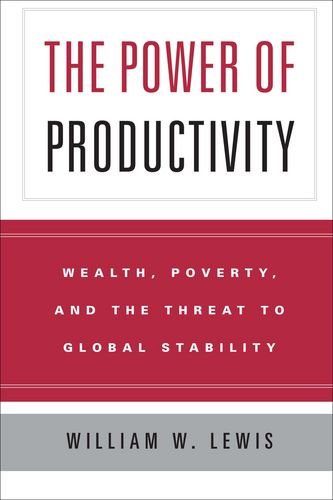
The Power of Productivity: Wealth, Poverty, and the Threat to Global StabilityBy William W. Lewis

PDF Ebook The Power of Productivity: Wealth, Poverty, and the Threat to Global StabilityBy William W. Lewis
There are several ideas that people supply to increase the life top quality, regarding every little thing. Here, we likewise will supply you an extremely easy suggestion to life better. Reading The Power Of Productivity: Wealth, Poverty, And The Threat To Global StabilityBy William W. Lewis is our idea. Please ask why we recommend this book to read. Many people attempt to make themselves to be abundant, but at some point they forget a really easy thing. Checking out is in fact a simple point, however several slouch to do it. It's sort of dull task as well as waste the time.
As a book, having the smart as well as discerning book is the common one to constantly remember. It has to select and also pick the most effective words selections or dictions that could influence the high quality of the book. The Power Of Productivity: Wealth, Poverty, And The Threat To Global StabilityBy William W. Lewis likewise includes the easy language to be comprehended by all people. When you think that this publication appertains with you, pick it currently. As a good book, it provides not just the features of the books that we have actually offered.
Well, have you located the means to obtain the book? Searching for The Power Of Productivity: Wealth, Poverty, And The Threat To Global StabilityBy William W. Lewis in guide shop will certainly be most likely tough. This is a popular publication as well as you could have left to buy it, meant sold out. Have you felt burnt out to come over again to the book shops to understand when the exact time to get it? Now, see this site to get just what you require. Below, we won't be sold out. The soft data system of this book truly helps everybody to obtain the referred book.
After getting guide, you can start your task to read it, also in your extra time every where you are. You could understand why we prepared make it as recommended publication for you. This is not only concerning the relevant topic for your analysis resource however additionally the more effective book with excellent quality components. So, it will certainly not make perplexed to feel stressed not to obtain anything from The Power Of Productivity: Wealth, Poverty, And The Threat To Global StabilityBy William W. Lewis
The disparity between rich and poor countries is the most serious, intractable problem facing the world today. The chronic poverty of many nations affects more than the citizens and economies of those nations; it threatens global stability as the pressures of immigration become unsustainable and rogue nations seek power and influence through extreme political and terrorist acts. To address this tenacious poverty, a vast array of international institutions has pumped billions of dollars into these nations in recent decades, yet despite this infusion of capital and attention, roughly five billion of the world's six billion people continue to live in poor countries. What isn't working? And how can we fix it?
The Power of Productivity provides powerful and controversial answers to these questions. William W. Lewis, the director emeritus of the McKinsey Global Institute, here draws on extensive microeconomic studies of thirteen nations over twelve years—conducted by the Institute itself—to counter virtually all prevailing wisdom about how best to ameliorate economic disparity. Lewis's research, which included studying everything from state-of-the-art auto makers to black-market street vendors and mom-and-pop stores, conclusively demonstrates that, contrary to popular belief, providing more capital to poor nations is not the best way to help them. Nor is improving levels of education, exchange-rate flexibility, or government solvency enough. Rather, the key to improving economic conditions in poor countries, argues Lewis, is increasing productivity through intense, fair competition and protecting consumer rights.
As The Power of Productivity explains, this sweeping solution affects the economies of poor nations at all levels—from the viability of major industries to how the average consumer thinks about his or her purchases. Policies must be enacted in developing nations that reflect a consumer rather than a producer mindset and an attendant sense of consumer rights. Only one force, Lewis claims, can stand up to producer special privileges—consumer interests.
The Institute's unprecedented research method and Lewis's years of experience with economic policy combine to make The Power of Productivity the most authoritative and compelling view of the global economy today, one that will inform political and economic debate throughout the world for years to come.
- Sales Rank: #419698 in Books
- Published on: 2004-04-16
- Original language: English
- Number of items: 1
- Dimensions: 9.00" h x 1.20" w x 6.00" l, 1.67 pounds
- Binding: Hardcover
- 370 pages
From Publishers Weekly
Lewis, founding director of the McKinsey Global Institute and former partner at McKinsey & Company, offers a detailed look at the local economies in several parts of the world including the U.S., Japan, India and Brazil. Based on the Institute's 12-year survey and analysis, Lewis concludes that the great economic disparity between rich and poor countries will ultimately have a negative impact on all nations. Lewis and his team examined individual industries within a country to evaluate the productivity per employee. The specific country-by-country distillations are easily understood, regardless of one's familiarity with economic theory, and readers will not be surprised by Lewis's discussion of the thriving Japanese economy, successful largely because of its domination of the automobile market. However, the more detailed analysis of Japanese business, which is limited by government policy including restrictive land regulations that have kept larger retailers like Wal-Mart away, is quite informative. The author's examination of American domestic productivity is also clear and accessible: in the 1990s, growth occurred in only six sectors, including four technological areas—security brokers, microprocessors, computer assembly and mobile telephone services. As evidenced by the tech bubble, slowed growth in these fields has hurt the economy. Lewis concludes by explaining how various factors, including education, government controls and cooperation among countries, will play a part in future international economic stability. This is an insightful treatment of a complex issue that deserves a wide readership.
Copyright © Reed Business Information, a division of Reed Elsevier Inc. All rights reserved.
Review
“The question Lewis set out to answer was why poor countries are poor and rich ones rich. It had been asked before, and answered by looking at the big differences between nations: history and culture, capital markets, labor markets, etc. Lewis’ approach was to look at specific businesses. He made a point not to focus on export industries, like cars in Japan and software in India. Each is only a sliver of that country’s employment. . . . This is a valuable book. . . . Lewis confirms much of the free-market canon, and in a way that the free-marketeers have generally not done and some of them refuse to do. They should read it.”--Bruce Ramsey, Liberty (Bruce Ramsey Liberty)
“Bill Lewis’s book aims to distill the lessons from a large body of original research on a question of enormous importance: what determines the performance, especially the productivity performance, of national economies and the industries within them? I was able to participate in much of the research, and I can report that I learned a lot about the sources of productivity in both the manufacturing and service sectors of modern economies. The obvious answers are only part of the story. Readers all around the world will see vital issues in a new light.”Robert M. Solow, winner of the 1987 Nobel Prize in Economics (Robert M. Solow, winner of the 1987 Nobel Prize in Economics)
“One of the central questions of economics concerns why some countries are rich, why other countries are poor, and how poor countries can best be helped to become rich. Among the many authors of books on this subject, Bill Lewis has the big advantage that the governments of many major countries asked him and his colleagues to investigate their economies and to advise them. His comparative perspective, consistent framework, and crystal-clear writing make this book a compelling read. It is also a delightful and surprising read: for instance, you probably never guessed why Japan produces automobiles much more efficiently than it produces milk.”Jared Diamond, Professor of Geography at UCLA and author of the Pulitzer Prize-winning book Guns, Germs, and Steel (Jared Diamond, Professor of Geography at UCLA and author of the Pulitzer Prize-w)
“A “bottom up” analysis of productivity (as opposed to the usual macroeconomic approach) that is fascinating, diverse, and complex.”--Richard N. Cooper (Richard N. Cooper Foreign Affairs)
From the Inside Flap
The disparity between rich and poor countries is the most serious, intractable problem facing the world today. The chronic poverty of many nations affects more than the citizens and economies of those nations; it threatens global stability as the pressures of immigration become unsustainable and rogue nations seek power and influence through extreme political and terrorist acts. To address this tenacious poverty, a vast array of international institutions has pumped billions of dollars into these nations in recent decades, yet despite this infusion of capital and attention, roughly five billion of the world's six billion people continue to live in poor countries. What isn't working? And how can we fix it?
The Power of Productivity provides powerful and controversial answers to these questions. William W. Lewis, the director emeritus of the McKinsey Global Institute, here draws on extensive microeconomic studies of thirteen nations over twelve years—conducted by the Institute itself—to counter virtually all prevailing wisdom about how best to ameliorate economic disparity. Lewis's research, which included studying everything from state-of-the-art auto makers to black-market street vendors and mom-and-pop stores, conclusively demonstrates that, contrary to popular belief, providing more capital to poor nations is not the best way to help them. Nor is improving levels of education, exchange-rate flexibility, or government solvency enough. Rather, the key to improving economic conditions in poor countries, argues Lewis, is increasing productivity through intense, fair competition and protecting consumer rights.
As The Power of Productivity explains, this sweeping solution affects the economies of poor nations at all levels—from the viability of major industries to how the average consumer thinks about his or her purchases. Policies must be enacted in developing nations that reflect a consumer rather than a producer mindset and an attendant sense of consumer rights. Only one force, Lewis claims, can stand up to producer special privileges—consumer interests.
The Institute's unprecedented research method and Lewis's years of experience with economic policy combine to make The Power of Productivity the most authoritative and compelling view of the global economy today, one that will inform political and economic debate throughout the world for years to come.
The Power of Productivity: Wealth, Poverty, and the Threat to Global StabilityBy William W. Lewis PDF
The Power of Productivity: Wealth, Poverty, and the Threat to Global StabilityBy William W. Lewis EPub
The Power of Productivity: Wealth, Poverty, and the Threat to Global StabilityBy William W. Lewis Doc
The Power of Productivity: Wealth, Poverty, and the Threat to Global StabilityBy William W. Lewis iBooks
The Power of Productivity: Wealth, Poverty, and the Threat to Global StabilityBy William W. Lewis rtf
The Power of Productivity: Wealth, Poverty, and the Threat to Global StabilityBy William W. Lewis Mobipocket
The Power of Productivity: Wealth, Poverty, and the Threat to Global StabilityBy William W. Lewis Kindle
The Power of Productivity: Wealth, Poverty, and the Threat to Global StabilityBy William W. Lewis PDF
The Power of Productivity: Wealth, Poverty, and the Threat to Global StabilityBy William W. Lewis PDF
The Power of Productivity: Wealth, Poverty, and the Threat to Global StabilityBy William W. Lewis PDF
The Power of Productivity: Wealth, Poverty, and the Threat to Global StabilityBy William W. Lewis PDF

Subscribe to:
Post Comments (Atom)
0 comments: